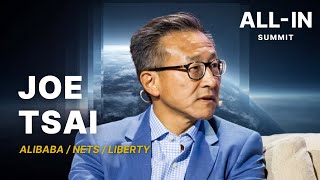
Joe Tsai on US-China Rivalry, AI's Future, Owning the Nets/Liberty, Caitlin Clark's Major Impact
Episode Details
In this discussion, Joe Tsai, the Chairman of Alibaba and owner of the Brooklyn Nets and New York Liberty, provides insights into sports, business, and geopolitics. He begins by detailing the profound economic impact of Caitlin Clark on the WNBA, which saw metrics quadruple, and comments on his role within the NBA's influential NBA Competition Committee. Tsai then reflects on Alibaba's journey, crediting the visionary Leadership of co-founder Jack Ma during an era of Freewheeling Capitalism in China. He contrasts this with the current environment shaped by increased government Regulation (in China), creating a predictable but intensely competitive landscape where Alibaba's focus on its core businesses of E-commerce and Cloud Computing is crucial to managing its Corporate Culture and competing with rivals like ByteDance and its Tik Tok app. A central focus of the conversation is the US-China Rivalry. Tsai advocates for a cooperative approach, while host David Sacks, citing scholar Professor Mearsheimer, presents the United States' perspective as one driven by the necessity to remain the world's sole superpower, leading to inevitable competition with a rising China. This conflict is most pronounced in the global AI Race. Tsai redefines 'winning' not as creating the superior model, but as achieving the fastest AI Adoption. He points to China's rapid progress, where corporate use of AI (Artificial Intelligence) has soared, supported by strategies like embracing Open Source AI and massive investment from Hyperscalers. He also touches on significant domestic challenges facing China, including high Youth Unemployment in China and a persistent Chinese Property Slump, and notes that the fear of AGI (Artificial General Intelligence) is less prevalent there due to a belief in state control.
Key Topics & People

The delivery of computing services over the internet, critical for hosting AI models.

Broad field of intelligence software described as a great economic leveler.
Investor and podcast host offering insights on geopolitical conflicts, US policy, and politics.

The business of buying and selling online, forming the core industry for Chewy, Amazon, and eBay.
Large cloud service providers that stand to gain an oligopoly through heavy AI regulation.

The country facing a massive inflection point in economic growth, infrastructure needs, and supply chain fragility.
OpenAI's core mission to develop broadly capable and universally beneficial artificial intelligence.

The ongoing geopolitical, technological, and economic competition between the United States and China, prominently featuring an AI arms race.
Economic challenge facing China with rates reaching 15-20%.

The critical capacity to govern and guide the nation through complex domestic and international crises.
The prevailing workplace ethos, which leaders aim to protect from ideological distraction and poor critical thinking.
The movement and development of AI models with publicly accessible source code, such as Llama and Mistral, which are seen as a major competitive threat to closed-source models.
An international relations scholar cited for his early prediction that facilitating China's economic rise would inevitably create a geopolitical competitor to the United States, challenging the prevailing 'End of History' consensus.
.jpg?width=300)
A WNBA player whose entry into the league had an extraordinary economic impact, increasing viewership, ticket sales, and sponsorships by approximately 4x.
The process of integrating AI into businesses and society. Tsai highlights this as the true measure of success in the AI race, noting that China's adoption rate among firms has jumped from 8% to nearly 50% in a year.
A period, described by Tsai as the first 15 years of Alibaba's existence, characterized by a free-market environment and a 'Cambrian explosion' of entrepreneurs before increased government regulation.
An NBA committee responsible for rules and refereeing changes. Joe Tsai is a member and argues it should be called the 'product committee' because its decisions directly shape the fan experience.

An NBA team owned by Joe Tsai. Tsai mentions the team is currently in a 'rebuilding year.'

A WNBA team owned by Joe Tsai.
A major downturn in China's real estate market over the last 4-5 years, with average home prices down 30%, creating a negative wealth effect that is still lingering in the economy.
A period of increased government oversight in China's tech sector, which Tsai describes as a shift from a 'free market' to a more predictable environment with clear 'red lines' for companies like Alibaba.
_(cropped).jpg?width=300)