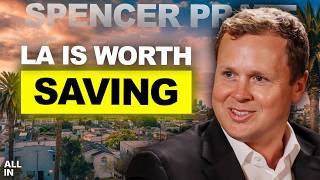
Spencer Pratt on Fixing LA: Wildfires, Homelessness, Corruption & the Fight to Take It Back
Episode Details
In a wide-ranging interview on the All-In Podcast, former reality star Spencer Pratt discusses his populist campaign for Mayor of Los Angeles, mirroring the outsider approach of Donald Trump. Pratt's political awakening occurred when he lost his home in the Palisades Fire, part of the broader crisis of LA Wildfires. He strongly criticizes city and state officials for their incompetence, pointing to the LADWP and its former CEO Janice Quinionz for draining vital reservoirs, requiring federal and state intervention from the US Forest Service (discussed with chief Bobby Garcia) and CalFire. Pratt blames this disaster on the overarching Political Corruption in the city. Pratt is fiercely opposing incumbent Mayor Karen Bass and councilwoman Nithya Raman, tying their destructive governance to the Democratic Socialists of America (DSA) and the radical ideology of Socialism. He contrasts this radicalism with traditional figures of the Democratic Party like Bill Clinton, and appeals to voters across the aisle, including the Republican Party. Pratt even consulted billionaire Rick Caruso and is fighting against the broader state machine led by California Governor Gavin Newsom. At the center of Pratt's platform is the rampant Homelessness crisis, which he correctly diagnoses as a severe Addictions and mental health problem. He accuses NGOs, specifically naming FireAid and the Weingart Center, of siphoning billions of taxpayer dollars with zero accountability. To end this, he plans to deploy the IRS to audit these corrupt entities and bring in the CDC to manage medieval disease outbreaks in the encampments. To help displaced populations, he references Matt Hes’s veteran facility in Bentonville as a successful model. To combat rampant Crime plaguing areas like Downtown LA and the affluent Palisades, Pratt intends to untie the hands of the Los Angeles Police Department and Los Angeles Fire Department. He looks to San Francisco Mayor Daniel Lurie as a blueprint for enforcing the law, noting that real estate executive Victor Coleman praised Lurie’s success. Pratt also intends to audit and reform the heavily funded but failing LAUSD. Economically, Pratt vows to eliminate the crushing Bureaucratic Burden that strangles Small Business. He envisions using AI to automate city permitting overnight and leveraging 3D printing for rapid architectural construction. He intends to fund major civic renewals through a Public private partnership model with willing billionaires. Finally, aiming to restore Hollywood, Pratt relies on advice from media heavyweight Peter Chernin to prioritize Independent filmmakers over entrenched studio models. While he intends to court major executives like Ted Sarandos and David Ellison, his focus is on grassroots creators. Backed by high-profile supporters like music producer David Foster, Pratt is determined to make Los Angeles the number one city in the world.
The episode features a populist critique of municipal governance in Los Angeles, focusing on the intersection of public safety, bureaucratic inefficiency, and corruption. The primary investment themes involve the potential for civic renewal through private-public partnerships, the application of technology to streamline municipal permitting, and the revitalization of independent media production.
Portfolio lens: This set of ideas represents a bet on the 'unbundling' of municipal services and media production, where private sector efficiency and decentralized technology replace legacy bureaucratic and studio models.
Generated with gemini-3.1-flash-lite on 7/19/2026, 5:40:40 AM. For research only. Not financial advice.Civic Infrastructure & Public-Private Partnerships
Urban renewal in major metropolitan areas can be accelerated by bypassing failing public agencies through private-public partnerships and private capital deployment.
The episode highlights a model where private capital and expertise are used to fund and manage public services like fire suppression, housing, and infrastructure when local government fails to deliver.
- The guest mentions securing interest from anonymous billionaires to fund civic projects.
- The guest references a veteran housing facility model in Bentonville as a blueprint for private-led social services.
- The guest discusses using private architects to bypass slow city permitting processes.
- Election of reform-minded local leadership.
- Increased failure rates of traditional municipal agencies.
- Successful pilot programs of private-funded public infrastructure.
- Regulatory pushback from entrenched city bureaucracies.
- Legal challenges regarding the privatization of public services.
- Difficulty in scaling private models to meet city-wide demand.
- Analyze existing public-private partnership laws in California.
- Review municipal budget allocations for infrastructure vs. actual project completion rates.
Independent Media & Content Production Ecosystems
The shift toward independent content production creates an opportunity for platforms and services that support non-studio creators.
The episode suggests that the traditional studio model in Hollywood is being supplanted by independent creators who require different support structures, decentralized production, and new distribution channels.
- The guest notes that independent creators are doubling down on indie routes.
- The guest emphasizes prioritizing independent filmmakers over entrenched studio models.
- The episode mentions the potential for AI to automate and accelerate production workflows.
- Decline in traditional studio market share.
- Increased adoption of AI-driven production tools.
- Policy changes that reduce permitting fees for independent crews.
- Dominance of incumbent studio distribution networks.
- High cost of production in urban centers like LA.
- Regulatory hurdles for independent production on public property.
- Track growth metrics of independent production houses vs. major studios.
- Monitor adoption rates of AI tools in film and video production.
Watchlist
- LA municipal bond yields
- LA city permitting volume metrics
- Independent film production permit filings
- NGO audit reports in Los Angeles
- axon.ai
Open Questions
- What are the specific legal mechanisms to allow private entities to manage public fire suppression assets?
- How do current zoning laws in major cities restrict the use of 3D printing in rapid construction?
- To what extent can municipal permitting be automated via AI without violating existing safety codes?
Key Topics & People
Political organization pushing a progressive agenda and sweeping local elections in New York.
The podcast hosting the interview with GameStop CEO Ryan Cohen.

US President who announced the brokering of a comprehensive Middle Eastern peace deal.

Governor of California who signed laws regarding election audits.

Candidate in the Los Angeles mayoral election.

Candidate in the Los Angeles mayoral election.

Candidate in the Los Angeles mayoral election.

City in California holding a disputed mayoral election.

The political party of Senator McCormick, which seeks to build working-class coalitions across rural and urban centers.
The political party of Senator Fetterman, which he critiques for shifting too far left and prioritizing outrage politics.

A US state used as an example of grid fragility, particularly concerning electric vehicle charging demands and historical fires.

California city struggling with high crime and urban decay.
.jpg?width=300)
Crisis tied to untreated drug addiction and mental illness.

.jpg?width=300)
Advanced construction method proposed to quickly build massive housing and infrastructure projects in LA.
Prominent real estate executive in LA who discussed San Francisco's successful recovery with Pratt.

Major media executive who advised Spencer Pratt to prioritize independent filmmakers.

Legendary music producer hosting a major fundraiser for Spencer Pratt's campaign.
Chief at the US Forest Service with whom Pratt discussed the failures of the fire response.
Former CEO of LADWP, directly blamed by Pratt for draining water reservoirs before the fire season.

The city's fire agency, whose members secretly support Pratt's mayoral run due to current leadership failures.
Federal agency that provided air support during the Palisades Fire due to the city's failures.

The city's police force, unable to enforce basic laws due to political mandates.

A specific homeless housing NGO cited by Pratt as a prime example of real estate and funding corruption.
The urban core of Los Angeles where restaurants are closing due to crime and drug epidemics.
Indie creators who Pratt sees as the key to saving the local Hollywood production economy.
Pratt's strategy of working with anonymous billionaires and private capital to rebuild Los Angeles structures.
The immense red tape, zoning laws, and uncoordinated permitting processes stalling progress in LA.
Local enterprises being crushed under bureaucracy, crime, and excessive permitting delays.
The massive substance abuse epidemic driving the visible street crises in Los Angeles.
The endemic misuse of public funds, kickbacks to developers, and shielding of officials in Los Angeles.
The overarching issue of destructive fires and poor city management surrounding them in Los Angeles.
.jpg?width=300)
A catastrophic wildfire that destroyed Spencer Pratt's home, sparking his political career.

Former US President referenced by Pratt as an example of a traditional, non-socialist Democrat.
Major media executive that Pratt's team contacted as part of his strategy to revive local film production.
.jpg?width=300)
Co-CEO of Netflix, whom Pratt reached out to regarding Hollywood's future.
Mayor of San Francisco whose strict law enforcement approach serves as inspiration for Pratt.

Billionaire and former mayoral candidate who Spencer Pratt consulted before deciding to run.