Episodes
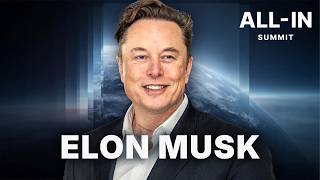
Elon Musk on DOGE, Optimus, Starlink Smartphones, Evolving with AI, Why the West is Imploding
All-In Podcast
9/9/2025
During an extensive interview on the All-In Podcast, Elon Musk provided a comprehensive update on his major ventures, speaking from the Tesla Global Engineering Headquarters in Palo Alto. He began by describing his vision for Optimus, predicting it would be humanity's greatest product. As a type of Humanoid Robots, its development hinges on solving the complex 'hands problem' to replicate human dexterity and requires significant Vertical Integration because a supply chain for its advanced Actuators doesn't exist. Musk also detailed Tesla's progress in silicon, announcing the upcoming AI5 chip, which he claims offers a 40-fold improvement over the current AI4 chip. This new hardware is expected to create an order-of-magnitude leap in the performance and safety of the FSD (Full Self-Driving) system. Shifting to SpaceX, Musk outlined the strategy for Starlink to provide high-bandwidth connectivity directly to smartphones. This plan is enabled by a recent $17 billion acquisition of Wireless Spectrum from Echoar, positioning Starlink as a future competitor to traditional carriers like Verizon. He also updated on the Starship program, expressing confidence in achieving Full Reusability (Rockets) by the next year, while acknowledging that creating a durable, fully reusable Orbital Heat Shield is the primary remaining engineering challenge. For his xAI venture, Musk explained that the next generation of Grok will be trained using vast amounts of Synthetic Data to correct and enhance
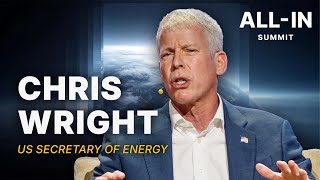
Energy Secretary Chris Wright on the Future of American Energy | All-In Summit 2025
All-In Podcast
9/8/2025
At the All-In Summit, U.S. Secretary of Energy Chris Wright detailed the Trump Administration's 'humans first' energy policy, which champions reliable and affordable power from Hydrocarbons like Natural Gas and Coal, and aims to revitalize Nuclear Energy. This revival includes fast-tracking next-generation Small Modular Reactors (SMRs), with a key demonstration project planned at the Idaho National Laboratory. Wright argued that policies driven by an 'irrational fear' of Climate Change have damaged the Electricity Grid by subsidizing intermittent sources like Solar Energy and Wind Energy, which he controversially labeled 'parasites'. He contrasted the U.S. situation with China's pragmatic strategy of rapidly building nuclear and coal plants while also dominating the solar supply chain. The discussion, featuring challenges from Jason Calacanis and David Sacks, heavily focused on the surging power demand from AI Data Centers. Wright's proposed solutions include expanding the use of Natural Gas and leveraging land at the nation's 17 National Labs for rapid data center construction. He explicitly rejected the views of Elon Musk on the future of Solar Energy and Batteries. In a counterpoint, panelist Chamath Palihapitiya reframed the debate, viewing energy as a core Energy as a National Security Issue and promoting a future with a Distributed Utility model powered by homeowner solar and Batteries. Wright also confirmed the spirit of the DOGE program continues within the Depa
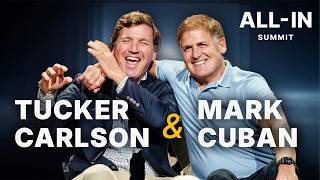
How to Save America: Mark Cuban and Tucker Carlson Debate 🔥 | All-In Summit 2025
All-In Podcast
9/8/2025
At the All-In Summit 2025, a lively debate between Mark Cuban and a surprise guest, Tucker Carlson, explored fundamental issues facing America. Mark Cuban championed market-driven solutions, centering his argument on the broken US Healthcare System. He detailed his venture, Cost Plus Drugs.com, co-founded with Dr. Alex Ashmayansky, as a direct assault on the lack of transparency and inflated costs caused by powerful PBMs (Pharmacy Benefit Managers) and the 'original sin' of Vertical Integration in Healthcare. Cuban expressed profound disillusionment with the American Two-party system, labeling both the Republican Party and Democratic Party as failures and advocating for a renewed focus on Entrepreneurship to solve national problems. On the other hand, Tucker Carlson provided a cultural and political diagnosis, identifying economic Populism—a strategy he attributes to both Donald Trump and rising figures like Zoran Mamdani—as the dominant force in politics. He articulated a vision of Western Societal Decline, linking it to rapid Population Change, a dire Housing Crisis, and a spiritual malaise he calls the SSRI Epidemic. The discussion also delved into technological disruption, with both speakers offering perspectives on AI Job Displacement and the future roles of AI (Artificial Intelligence) and Robotics. They touched upon the economic pressures of Federal Spending and debated contentious foreign policy issues, including aid to Ukraine and the complexities surrounding I
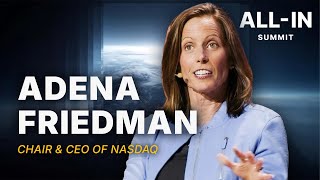
The New Era of the Stock Market with Nasdaq CEO Adena Friedman | All-In Summit 2025
All-In Podcast
9/8/2025
During the All-In Summit, host Jason Calacanis interviewed Nasdaq CEO Adena Friedman about the future of capital markets. Friedman detailed how Nasdaq has evolved from a stock exchange into a global technology company providing market infrastructure and anti-financial crime solutions. The centerpiece of the discussion was Nasdaq's announcement to integrate Tokenized Securities into its core markets, a move aimed at streamlining inefficient Post-trade processing and embracing blockchain technology from the Crypto world. This initiative, along with a shift towards 24/5 Trading, is designed to modernize markets for a global audience. Friedman also addressed the significant burdens of the current IPO Market, which contributes to the trend of companies like Uber, Stripe, and SpaceX Staying private longer, thereby concentrating wealth creation in Private Markets. She advocated for reforms and alternative avenues to the Public Markets, such as the Direct Listing model used by Spotify and the use of SPVs. The conversation highlighted the critical need for Regulatory Clarity to allow institutional players into the Crypto space, noting a positive, forward-leaning stance from the SEC under Chair Atkins and collaboration with the CFTC. With clear rules, Nasdaq could potentially compete with exchanges like Coinbase, Binance, and OKX. Drawing from her role on the board of the New York Fed, a part of The Fed, Friedman affirmed her belief in Fed Independence, its data
Inside the White House Tech Dinner, Weak Jobs Report, Tariffs Court Challenge, Google Wins Antitrust
All-In Podcast
9/7/2025
The All-In Podcast episode provides an inside look at several critical topics for entrepreneurs and business leaders. The discussion begins with a detailed account of the White House Tech Dinner, a significant event hosted by President Donald Trump to convene the titans of the tech industry. Attendees included Mark Zuckerberg, Tim Cook, Sam Altman, Bill Gates, and Sergey Brin, with co-hosts David Sacks and Chamath Palihapitiya playing key roles. The dinner's purpose was to align on a Pro-innovation Agenda and reinforce America's Technological Supremacy. A related discussion highlighted the work of First Lady Melania Trump in supporting AI education. The conversation then pivots to pressing legal and economic issues. A major segment analyzes the legal challenge to President Donald Trump's Tariffs, which were enacted using Emergency Powers and are now headed for a showdown at the Supreme Court. This raises broader questions about executive authority, a concern also voiced by Senator Rand Paul. On the economic front, the hosts dissect a Weak Jobs Report, expressing deep concerns about the state of the US Economy and the unreliability of data from the Bureau of Labor Statistics (BLS), which complicates policy decisions for the Federal Reserve. The discussion also touches on how tariff revenue funds policies like the Big Beautiful Bill (BBB) and the legal controversy surrounding the deployment of the National Guard. Finally, the episode concludes with an analysis of the Google Antit
Senator Rand Paul: Tariffs, Debt, China, and a Warning for America
All-In Podcast
9/5/2025
Senator `Rand Paul` presents a detailed exposition of his libertarian-conservative philosophy, deeply influenced by his father `Ron Paul` and economists like `Adam Smith`. A central theme is his staunch opposition to the growing `US National Debt`, which led him to be one of the few in the `Republican Party` to vote against the `Big Beautiful Bill (BBB)`. He is highly critical of `Protectionism` and specifically `Tariffs`, a key `Trade Policy` of `Donald Trump`, arguing they undermine `Capitalism` and the principles of the `Free Market`. Despite these significant policy disagreements, he maintains a personal relationship with Trump and would support him over `Kamala Harris` or `Joe Biden` and the `Democrats`. He warns that the `US Economy` is built on a house of cards, citing the `Global Financial System Fragility` due to the `Fractional Reserve System` and the potential for a flight from the `US Dollar`, a concern amplified by the actions of the `Federal Reserve (Fed)`. The Senator also dives deep into the topic of his book, `Deception, The Great COVID Coverup`, accusing Dr. `Anthony Fauci` of orchestrating a `COVID Cover Up` to hide the fact that dangerous `Gain-Of-Function Research` funded by the U.S. was outsourced to `China`. He contends that this alleged dishonesty has eroded public trust and fueled `Vaccine Hesitancy`. On foreign policy, he discusses `US-China Relations` in the context of a new alliance between `Xi Jinping`, `Vladimir Putin`, and `Kim
Trump Takes On the Fed, US-Intel Deal, Why Bankruptcies Are Up, OpenAI's Longevity Breakthrough
All-In Podcast
8/29/2025
This episode of the All-In Podcast delves into several major themes at the intersection of politics, economics, and technology. The discussion, led by hosts Jason Calacanis, Chamath Palihapitiya, David Sacks, and David Friedberg, begins with the escalating conflict between Donald Trump and the Federal Reserve (Fed). This is highlighted by the unprecedented firing of Fed Governor Lisa Cook, a nominee of Joe Biden, which has led to a legal challenge expected to reach the Supreme Court and a criminal referral to the DOJ (Department of Justice). The hosts debate the core issue of Fed Independence, with Sacks arguing that Chair Jerome Powell's decisions on Monetary Policy have been politically influenced by figures like Elizabeth Warren, referencing analysis from Stan Druckenmiller. The conversation then shifts to a new industrial strategy, the US-Intel Deal, where the US Government, with input from Howard Lutnik, has taken an equity stake in Intel instead of providing grants under the CHIPS Act. This Equity for Grants Model is presented as a strategic necessity for National Security to compete with China's state-backed industries and reduce reliance on foreign manufacturers like TSMC. This deal sparks a proposal for a Sovereign Wealth Fund, with Friedberg suggesting its returns could be directed to the OASI (Old Agent Survivors Insurance Fund) to solve the looming Social Security crisis, a move that would require an act of Congress. The economic analysis continues

AI Bubble Pops, Zuck Freezes Hiring, Newsom’s 2028 Surge, Russia/Ukraine Endgame
All-In Podcast
8/22/2025
The All-In Podcast provides an in-depth analysis of a significant market correction in artificial intelligence, the emerging landscape for the 2028 presidential election, and the diplomatic endgame for the Russia-Ukraine war. The discussion begins with the event termed AI Mania hits the brakes, which the hosts debate as either a bursting AI Bubble or a healthy correction within a longer AI super cycle. This market shift was triggered by an influential MIT Generative AI study revealing that 95% of corporate AI pilots fail, with the highest ROI found in Back office optimization, and by cautious comments from OpenAI CEO Sam Altman. A major signal of this trend was the AI hiring freeze at Meta, instituted by CEO Mark Zuckerberg. Chamath Palihapitiya of 8090 offers a founder's perspective, detailing the practical difficulties of deploying Probabilistic Software. David Sacks tempers expectations, arguing that the industry is far from achieving AGI (Artificial General Intelligence) through Recursive self-improvement, a point underscored by the incremental progress of GPT-5. Jason Calacanis frames the current market sentiment within the Trough of Disillusionment. The technological conversation, led by David Friedberg, points to a strategic shift away from monolithic LLMs towards more efficient SLMs (Small Language Models) and successful Vertical AI Applications. This specialization is seen across the industry, with Google excelling in video, Anthropic in coding, and Grok offe
AI Psychosis, America's Broken Social Fabric, Trump Takes Over DC Police, Is VC Broken?
All-In Podcast
8/15/2025
In this episode of the All-In Podcast, hosts Jason Calacanis, Chamath Palihapitiya, David Sacks, and David Friedberg tackle a range of critical topics for entrepreneurs. The discussion opens with the concerning trend of AI Psychosis, a delusional state triggered by interactions with LLMs like OpenAI's ChatGPT. David Friedberg details the technical causes, including AI model feedback loops and context poisoning, while Chamath Palihapitiya connects it to the broader loneliness epidemic (a term coined by Scott Galloway) and the neurochemical difference between dopamine-driven online platforms like Instagram and the serotonin-based connections of real life. David Sacks remains skeptical, likening the concern to past moral panics over technologies like AOL, while psychiatrist John Taus is quoted suggesting pre-existing conditions are necessary triggers. The conversation then pivots to the erosion of America's social fabric and the increasingly elusive American Dream. The hosts identify economic drivers like the federal student loan program and the federal home loan program, which have inflated the costs of higher education and housing. They also point to a decline in the quality of K through 12 education and societal shifts, such as the aftermath of the Me Too movement, as contributing factors to social fragmentation. On the political front, the group analyzes Donald Trump's decision to invoke the DC Home Rule Act of 1973 to deploy the National Guard and