Episodes
Eric Schmidt on AI, the Battle with China, and the Future of America
All-In Podcast
9/24/2025
Former Google CEO Eric Schmidt presents a multifaceted worldview for founders, touching on technology, geopolitics, and business strategy. He strongly opposes Remote work for young professionals, advocating for in-person mentorship. Schmidt provides a nuanced analysis of the US vs China AI competition, explaining that while the US pursues ambitious goals like AGI (Artificial General Intelligence), China is strategically focused on applying existing AI to everything, from consumer apps to robotics, and is winning global influence by promoting Open source AI, a direct challenge to the predominantly Closed source AI approach of the West. This competition is underscored by China's intense 996 work culture and technical advances in areas like Numeric Precision in AI. On the hardware front, Schmidt discusses his leadership at Relativity Space, which builds Rockets to compete with SpaceX, and offers profound insights into the evolution of warfare based on the Ukraine War. He describes Drone warfare as a paradigm shift, where cheap Drones can neutralize expensive military assets, and where Ukraine effectively uses technologies like Starlink for command. Geopolitically, Schmidt voices concerns about the Decline of the West and global Population Decline, but ultimately champions American exceptionalism, urging the nation to leverage its unique strengths in capital markets and innovation. On the future of AI, he counters the San Francisco narrative by predicting AGI (Artificial Genera

Charlie Kirk Murder, Assassination Culture in America, Jimmy Kimmel Suspended, Ellison Media Empire
All-In Podcast
9/19/2025
This episode of the All-In Podcast provides an in-depth analysis of the Murder of Charlie Kirk, treating it as a critical inflection point for American society. The hosts, David Sacks, Chamath Palihapitiya, Jason Calacanis, and David Friedberg, begin by mourning Charlie Kirk, the influential founder of Turning Point and a key figure in the MAGA movement, whom Sacks considered a friend. They dissect the profile of the killer, Tyler Robinson, framing him as an exemplar of a lost COVID Generation suffering from Online Radicalization and an ideologically incoherent worldview dubbed Salad Bar Extremism. This act is viewed as a stark manifestation of a rising Assassination Culture and the growing acceptance of Political Violence, which threatens to destroy Public Discourse and the principle of Free Speech. The conversation then shifts to the media's reaction, focusing on the Suspension of Jimmy Kimmel by ABC. The hosts detail how Kimmel's false accusation against the MAGA movement led to his downfall, which was accelerated by pressure from the FCC under Brendan Carr and the network's largest affiliates, NextStar and Sinclair, igniting a debate on Cancel Culture versus consequences. This media turmoil serves as a backdrop for a discussion on the strategic moves shaping the future of media, particularly the rise of the Ellison Media Empire. They analyze how David Ellison of Skydance and his father Larry Ellison of Oracle are driving Media Consolidation with th
Solana’s Anatoly Yakovenko on Crypto's Next Era: Quantum, AI, and the Future of Money
All-In Podcast
9/18/2025
In a comprehensive discussion on the future of crypto, Anatoly Yakovenko, CEO of Solana Labs and co-founder of Solana, outlines the industry's evolving landscape. He highlights a dramatic improvement in the US regulatory environment, crediting figures like David Sacks for a positive shift away from what he describes as the hostile regime of Gary Gensler. Yakovenko is optimistic about legislation like the Genius Act, predicting it will unlock trillions in Stablecoins, which will in turn drive massive demand for US Treasuries and help export American Finance globally. He strategically differentiates Solana as the 'World's Execution Layer' focused on speed, from its competitor Ethereum, founded by Vitalik Buterin, which he defines as the 'World's Settlement Layer. ' Institutional interest is growing, as shown by BlackRock building on Solana and traditional players like Nasdaq exploring Tokenization of Securities. Looking ahead, Yakovenko sees immense potential in verticals like the Creator Economy on Blockchain, which requires the legal framework of the CLARITY Act to flourish, and in bringing Real World Assets on Blockchain to enhance risk management in DeFi. He also addresses significant technological challenges, warning that a breakthrough in Quantum Computing, potentially accelerated by AI, threatens current Cryptography. This necessitates a proactive migration of platforms like Bitcoin to Quantum-Resistant Cryptography, a move that would likely follow adoption by te
Uber CEO Dara Khosrowshahi on self-driving's future, changing business model, job displacement
All-In Podcast
9/17/2025
In a detailed discussion, Uber CEO Dara Khosrowshahi elaborated on the company's multifaceted strategy for navigating the future of transportation, with Autonomous Driving at its core. He emphasized that Uber's strength lies in its Network Effects, positioning it as an ideal platform to support the entire AV Ecosystem by maximizing vehicle utilization for partners. This is demonstrated through existing partnerships with leaders like Waymo in Atlanta and Austin, and numerous emerging players in China, a market rapidly advancing in Level 4 Autonomy. Khosrowshahi contrasted Waymo's sensor-rich approach using LiDAR and HD Maps with Tesla's Computer Vision-only strategy, extending an open invitation to Elon Musk to bring Tesla Robotaxis onto Uber's network to boost revenue for their owners, which Musk envisions as 'Digital Shepherds'. Uber's business model will transition to a Hybrid Network of human drivers and autonomous cars, largely maintaining its Asset-light business model long-term, despite a willingness to use its balance sheet to accelerate adoption. This financial strength is evidenced by a $20 billion Stock Buyback. Beyond ground transport, Uber is investing in the third dimension of urban mobility with EVTOL technology through its stake in Joby, and is innovating in its Uber Eats division with Sidewalk Robots and Drone Delivery. Khosrowshahi also noted a continuing working relationship with ventures from founder Travis Kalanick, such as Cloud Kitchens, and cand
The College Crisis: Heads of Dartmouth & Berkeley Debate the Decline of US Universities
All-In Podcast
9/16/2025
In a comprehensive debate on the crisis facing US Universities, Dartmouth President Sian Beilock and Berkeley Chancellor Rich Lyons addressed the eroding business model and public trust in higher education. The discussion was framed by the challenges of massive Student Loan Debt, which is tied to the Federal Student Loan Program, the questionable ROI of Higher Education for many graduates, and the internal problem of Administrative Bloat, which Rich Lyons specified Berkeley is tackling through an initiative against Bureaucratic Burden. The university leaders also delved into cultural issues, with both agreeing on the need to improve Viewpoint Diversity. Sian Beilock argued that DEI and merit are not mutually exclusive and emphasized the importance of Institutional Neutrality and Free Expression, referencing the University of Chicago as a model. The conversation touched on the external pressures from politics, such as actions by Donald Trump impacting the Ivy League (including Harvard), and the legal landscape shaped by the Supreme Court's rulings on Affirmative Action—a policy long banned in California. A significant concern raised was the K-12 Education Decline, which sends academically and socially unprepared students to college. Looking forward, the transformative potential of AI and AI in Higher Education was examined as a major disruptor, though a potential conflict with Teachers Unions was predicted. Despite challenges like Rising Graduate Unemployment, the lead
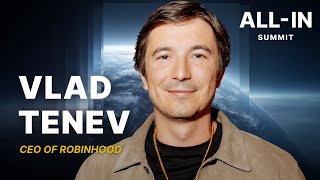
Robinhood CEO Vlad Tenev on tokenizing stocks, expanding access to private shares, fintech's future
All-In Podcast
9/15/2025
In a detailed discussion, Vlad Tenev, the CEO and founder of Robinhood, outlined the company's vision and recent strategic moves, notably its inclusion in the S&P 500. The core of the conversation centered on the innovative strategy of Tokenizing Securities, where Robinhood uses Blockchain technology to offer fractional ownership of private companies like OpenAI and SpaceX. This initiative was first launched in Europe with the goal of eventually bringing it to the US to provide retail investors with Access to Private Company Shares. This move prompted conversations with OpenAI's CEO, Sam Altman, and highlights the regulatory complexities involved. Tenev described a markedly improved relationship with the current White House administration compared to the last, seeing it as more open to innovation, though he still faces staunch opposition from critics like Senator Elizabeth Warren over concerns of Consumer Protection in Fintech. To achieve his vision in the US, Tenev advocates for a Relaxation of Accreditation Standards, pointing to the Genius Act for Stablecoins as a positive regulatory precedent from the US Government. The discussion also explored the broader market trend of Fintech Convergence, positioning Robinhood's ambition to become a Comprehensive Financial Platform as a direct challenge to fintech peers like Coinbase and Stripe, and financial incumbents like JP Morgan, Visa, and Mastercard. The podcast also featured a story from early investor Jason
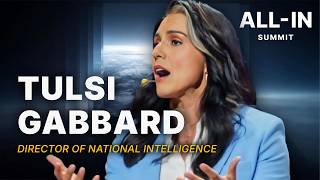
Tulsi Gabbard on Russiagate Hoax Evidence and How She’s Reforming Politicized Intelligence Agencies
All-In Podcast
9/15/2025
In an extensive interview on the All-In Podcast, Tulsi Gabbard, serving as Director of National Intelligence under President Donald Trump, laid out her case for the existence of a Russiagate Hoax. She claims this was a deliberate campaign of Politicized Intelligence designed to undermine Trump's presidency following his victory over Hillary Clinton in the 2016 US Presidential Election. According to Gabbard, the effort was orchestrated by the outgoing Obama Administration, with key figures like DNI James Clapper, CIA Director John Brennan, and FBI Director James Comey at the helm. She alleges they reversed the Intelligence Community's initial assessment—which found no evidence of Russia or its leader Vladimir Putin impacting the election outcome—by ordering a new assessment to prove interference. This involved leveraging unreliable sources like the Steel Dossier, which the CIA's own officials reportedly questioned, and launching the FBI's Crossfire Hurricane investigation, which used illegal warrants from the FISA court. Gabbard highlighted the resistance from then-NSA head Mike Rogers, who refused to endorse the assessment without proper vetting. She compares this event to the flawed Iraq War Intelligence that was allegedly manufactured under pressure from Vice President Dick Cheney. As head of the Office of the Director of National Intelligence (ODNI), Gabbard is declassifying documents and has referred the findings to the Department of Justice (DOJ) to ensure accountability

Google DeepMind CEO Demis Hassabis on AI, Creativity, and a Golden Age of Science | All-In Summit
All-In Podcast
9/12/2025
At the All-In Summit, Google DeepMind CEO and Nobel Prize laureate Demis Hassabis provided a deep dive into the state of AI (Artificial Intelligence) and its future trajectory. He framed his life's work as using AI to accelerate Scientific Discovery, a mission exemplified by the breakthrough AlphaFold technology. Hassabis described Google DeepMind's role as the central AI engine for both Google and its parent, Alphabet Inc., deploying models like the multimodal Gemini to billions of users. He unveiled Genie 3, a groundbreaking example of Interactive World Models that generates playable worlds from text by reverse-engineering Intuitive Physics, a critical step for advancing Robotics and developing embodied AI. Looking ahead, Hassabis predicted that AGI (Artificial General Intelligence) is likely 5-10 years away, but cautioned that achieving it will require more than just scaling Large Language Models (LLMs); it demands fundamental breakthroughs in areas he sees as currently lacking, such as true AI Creativity and Continual Learning. He also highlighted the rapid progress in creative tools like the VO model for video and the image generator Nano-Banana, which are fueling a Democratization of Creativity and being adopted by professionals like director Darren Aronowski. A significant portion of his time is now dedicated to Isomorphic Labs, a spinout company leveraging AlphaFold to revolutionize Drug Discovery through partnerships with pharmaceutical giants Eli Lilly and {
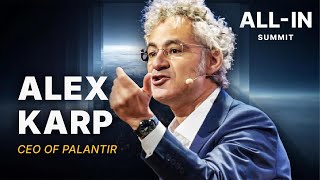
Palantir CEO Alex Karp: Why the West is Destroying Itself, Data Empire, Skeptics, How to Win
All-In Podcast
9/9/2025
In a detailed and philosophically dense interview, Palantir CEO Alex Karp robustly defends his company against its critics and outlines his diagnosis of a struggling Western world. He directly addresses the controversies surrounding Palantir's work with the US Government, particularly concerning Border Security and its contracts with agencies like ICE under both the Donald Trump and Joe Biden administrations. Karp argues that in the era of AI (Artificial Intelligence), controlled borders are essential and that his company's technology, including the Foundry platform, is crucial for effective governance while protecting Civil Liberties, refuting claims of enabling mass Data Collection and Surveillance. He asserts that the same architecture that ensures these protections is what allows enterprises to safely orchestrate LLMs. On the world stage, Karp confirms Palantir's support for Israel in its conflict with Hamas in places like Gaza and Qatar, and reaffirms the company's policy of not working with adversaries like China and Russia. He links China to the devastating Fentanyl crisis in America by supplying precursors to Mexican drug cartels, and uses his knowledge of Tai Chi as a metaphor for a strategy of building internal strength to counter external threats. The conversation's core theme, prompted by references to commentators like Tucker Carlson, is a critique of Western Societal Decline. Karp points to Europe, specifically Germany and France, as prime exampl