Episodes

YouTube CEO Neal Mohan on AI, Censorship & the Future of Creators
All-In Podcast
10/8/2025
In an extensive interview on the All-In Podcast, hosts Jason Calacanis and David Sacks spoke with YouTube CEO Neal Mohan about the platform's pivotal role in the digital landscape. Mohan emphasized YouTube's position as the world's largest Creator Economy, highlighting that the YouTube Partner Program has paid out over $70 billion to creators. Jason Calacanis challenged the fairness of the platform's 55/45 Revenue Split for top creators like Tucker Carlson and Mr. Beast, prompting a discussion on diverse monetization models. A significant portion of the conversation, initiated by David Sacks, tackled the controversial topic of Censorship on YouTube. Mohan acknowledged difficult decisions made during the pandemic but stated policies have since relaxed, noting the industry-wide influence of figures like Elon Musk in promoting a more open environment. This highlighted the inherent tension between content moderation, practices like Demonetization, and YouTube's core value of Free Speech. Mohan also detailed the success of subscription products like YouTube TV and YouTube Premium, the latter boasting 125 million subscribers. Looking ahead, he addressed the rise of Generative AI on YouTube, outlining a strategy that includes transparent labeling and a commitment to protecting creators' Likeness Rights. To achieve this, YouTube is developing a new Likeness Detection technology, using its foundational and highly successful Content ID system as a blueprint.
Biggest LBO Ever, SPAC 2.0, Open Source AI Models, State AI Regulation Frenzy
All-In Podcast
10/3/2025
In this episode, the All-In Podcast hosts, Jason Calacanis, Chimath Palihapitiya, David Friedberg, and David Sacks, dive into several major topics shaping the tech and economic landscape. They begin by analyzing the record-breaking $55B EA Acquisition, the largest leveraged buyout ever, which saw Electronic Arts (EA) taken private by a consortium including Silverlake, the Saudi PIF (Public Investment Fund of Saudi Arabia), and Jared Kushner's firm, Affinity Partners. The deal, supported by financing from Jamie Diamond, is seen as a major bet on AI in Gaming as the future of the Video Games industry, with the hosts arguing that gaming's Intellectual Property (IP) is more defensible against AI disruption than other media. Andrew Wilson is slated to remain as EA's CEO. This massive deal stands in contrast to the broader concern that the Private Equity industry is struggling. The discussion then moves to the dysfunctional IPO Market, which has led to the rise of alternatives like Direct Listing and problematic trends like continuation funds. This prompts Chimath Palihapitiya to detail his new SPAC 2.0 vehicle, designed as a cheaper, more efficient public market alternative. The podcast also explores the AI Rollup Opportunity, exemplified by Josh Kushner's strategy of acquiring traditional firms and transforming them with AI. The conversation shifts to the AI arms race, covering the launch of AI-generated content apps like OpenAI's Sora App and a similar product from Meta,

Ro Khanna on Crime, Censorship, Congress & Fixing What’s Broken
All-In Podcast
10/2/2025
In a wide-ranging conversation on the All-In Podcast, Representative Ro Khanna detailed his pragmatic progressive viewpoint on America's most pressing issues. The discussion began with Immigration, where Khanna called for reforming the H-1B visa program to curb abuse by IT consulting firms and create a better pathway to a Green Card, thereby retaining top talent like Google CEO Sundar Pichai and Microsoft CEO Satya Nadella. Khanna, a member of the Democratic Party, emphasized a 'first principles' approach, giving Donald Trump credit for identifying key national problems while disagreeing with his solutions and condemning the rise of Extreme Rhetoric in politics. He analyzed his party's failure to maintain its relationship with the Tech Industry in his home district of Silicon Valley—home to giants like Apple, Nvidia, Tesla, and Broadcom. Both Khanna and Trump were framed as proponents of Economic Patriotism, though with differing strategies. A significant focus was the competitive race in AI (Artificial Intelligence) with China, whose industrial advancements at companies like Xiaomi were highlighted as a serious challenge. Khanna also offered an insider's perspective on a looming Government Shutdown, attributing it to a constitutional clash over spending between Congress and the Joe Biden administration. He strongly defended Free Speech and warned against the escalating, bipartisan use of Censorship and Lawfare, citing examples from the suppression of the Hunter

Multicoin Capital’s Kyle Samani on Internet Capital Markets
All-In Podcast
10/1/2025
In a forward-looking presentation, Kyle Samani, founder of Multicoin Capital, declared that 2025 marks a generational inflection point for finance with the rise of Internet Capital Markets. He posits that the current, inefficient Legacy Financial System, a 100-year-old structure born from the Stock Market Crash of 1929 and subsequent US Securities Legislation (1930s-40s), is set to be consumed by a new paradigm. This shift is enabled by the convergence of two critical forces: technology and regulation. Technologically, modern Blockchains like Solana are now mature enough to handle internet-scale transactions cheaply and efficiently. Regulatorily, a favorable environment is rapidly forming, spearheaded by President Trump's pro-Crypto executive orders (with assistance from David Sacks) and key legislation from Congress, including the Genius Act for Stablecoins and the forthcoming Clarity Act. A crucial component of this new landscape is the SEC's proactive stance under Chair Paul Atkins, who is driving a 'digital finance revolution' through his vision for a Regulation Super App. This framework will allow companies like Robin Hood, Coinbase, and Sofi to offer seamless access to diverse assets—including crypto, Tokenized Securities, and traditional securities—on a single interface. This will bridge regulated markets with the world of permissionless DeFi, making protocols like GTO, Drift, and Commamino accessible to a global audience and sparking an 'absolute boom' in on-chain

Rick Caruso on California’s Collapse: Broken Leadership, LA Wildfire Failures & the Fix
All-In Podcast
9/30/2025
Developer and potential candidate Rick Caruso offers a sharp critique of the political Leadership in California and Los Angeles, framing the response to the recent LA Wildfires as a catastrophic failure of governance. He singles out Mayor Karen Bass as an example of Government Incompetence, contrasting her administration's inaction with his own proactive measures, such as hiring Private Firefighters to save his property in the Palisades and even loaning equipment to the ill-prepared LA Fire Department. Caruso argues the disaster was preventable and that the subsequent Rebuilding Efforts are being severely hampered by bureaucratic Red Tape. This specific crisis serves as a launchpad for a broader discussion on the state's decline, including rampant Homelessness and Urban Decay. He advocates for a return to basic competence, supporting robust Policing and a business-like focus on results, a philosophy he says is rooted in an Attention to Detail evident in his developments like The Grove. While offering measured praise for Governor Gavin Newsom's limited actions, Caruso calls for more decisive leadership. The conversation also explores the extreme possibility of the Federal Government deploying the National Guard to manage cities where local leaders have failed.

Arm CEO Rene Haas on AI: Nvidia Lessons, Intel’s Decline and the US-China Chip War
All-In Podcast
9/30/2025
In a detailed discussion, Arm CEO Rene Haas provides a founder-focused overview of the semiconductor landscape, shaped by his experiences at both Arm and Nvidia. He credits Nvidia CEO Jensen Huang's visionary leadership for the company's dominance, which was catalyzed by the AlexNet breakthrough proving the GPU's power for AI's parallel Compute Workloads. Haas highlights the symbiotic relationship where Arm's CPU architecture is a critical component in Nvidia's most advanced platforms, such as Grace Blackwell. Looking forward, he identifies two major market shifts: the bifurcation of the AI chip market into Training vs Inference, with inference becoming more competitive from players like Google with their TPUs, and the rise of a massive new market in Physical AI for robotics, where Arm's energy efficiency is a key advantage. The interview contrasts this growth with the decline of Intel, which Haas attributes to strategic failures in mobile and underinvestment in EUV manufacturing, ceding leadership to TSMC. Based in Taiwan, TSMC now manufactures for all leading-edge players, including Apple, Nvidia, and AMD. The conversation also navigates the complex geopolitical terrain of the US-China Chip War, a conflict in which US Export Controls are a key tactic. This dynamic is pushing China to leverage its strong Industrial Policy, which has already allowed it to dominate sectors like Rare earths refinement. Haas addresses the challenges of Manufacturing in

Science Corner Special! David Friedberg, Cleo Abram, Alex Filippenko, and Keller Rinaudo Cliffton
All-In Podcast
9/29/2025
In a special Science Corner edition hosted by David Friedberg at the All-In Summit, the discussion features three innovators at the forefront of science communication and technology. The first guest, Cleo Abram, shares her journey from being a journalist at Vox to becoming a leading independent creator on YouTube with her channel Huge If True. She explains how the platform has enabled a new Creator Economy, allowing her to pursue her mission of spreading Techno-optimism by showcasing how technology can solve complex problems. Next, astrophysicist Alex Filippenko from UC Berkeley delivers a presentation on the revolutionary James Webb Space Telescope, a project born from International Collaboration led by NASA. He details how the telescope is providing unprecedented views of the early universe, studying Exoplanets for signs of life, and challenging existing models of galaxy formation. In the Q&A, Filippenko reaffirms the robustness of the Big Bang Theory using evidence like the Cosmic Microwave Background Radiation, explores intriguing concepts like Black holes, the Fermi Paradox, and the Great Filter, and argues for funding pure research by highlighting its history of producing major Technological spin-offs from fields like Quantum physics. He concludes with a stark warning about recent cuts to scientific funding, specifically mentioning NIH Grants. Finally, Keller Rinaudo Cliffton, co-founder and CEO of Zipline, presents his company's pioneering work in creating the world's
Inside the GLP-1 Gold Rush: Eli Lilly CEO on New Breakthroughs, Addiction & Mental Health, Pricing
All-In Podcast
9/28/2025
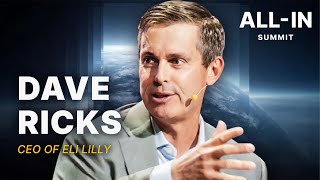
In a detailed discussion, Eli Lilly CEO Dave Ricks unpacks the story behind the 'GLP-1 Gold Rush,' charting the evolution of GLP-1 drugs from a treatment for Diabetes to a revolutionary therapy for Weight Loss and Obesity. He highlights the phenomenal success of Tirzepatide, which surpassed Keytruda as the world's top-selling drug in Q2. Ricks confronts the controversial topic of GLP-1 Pricing, explaining the delicate balance between increasing access and funding future R&D, while also announcing an upcoming Oral GLP-1 pill. A significant portion of the company's strategy involves aggressive Capital Allocation towards expanding its Supply Chain by building numerous manufacturing plants in the United States, a commitment he references in connection with President Trump. The conversation also explores major market headwinds, including the proliferation of Counterfeit Products from China, the strategic threat of Patent Hacking which is influenced by the American Invents Act, and the challenging investment climate for Biotech VC. Looking ahead, Ricks reveals unexpected applications for GLP-1s in curbing Addictions and treating Mental Health conditions, potentially disrupting the market for SSRIs. He also touches on broader industry issues, criticizing the role of PBMs, questioning the efficiency of NIH funding, and explaining how outdated FDA regulations shape modern Pharma Advertising. Ricks sees AI in Healthcare as a positive force for patient empowerment and predicts t

H-1B Shakeup, Kimmel Apology, Autism Causes, California Hate Speech Law
All-In Podcast
9/26/2025
In this episode, the All-In Podcast hosts Jason Calacanis, Chamath Palihapitiya, David Sacks, and David Friedberg dive into several major topics. They begin with a detailed analysis of the Trump Administration's proposed overhaul of the H-1B visa program, including a new $100,000 fee. The hosts largely agree that the system has been abused, particularly by IT consulting firms practicing labor arbitrage, to the detriment of American workers. David Friedberg suggests a modern-day Operation Paperclip as a more strategic alternative for talent recruitment, while Chamath Palihapitiya notes that OPT already provides a pathway for high-skilled graduates. Next, they tackle the controversial press conference held by Donald Trump and Bobby Kennedy regarding a potential link between Autism and Tylenol (acetaminophen) use during pregnancy. They discuss a paper by Andrea Bakarelli and explore a scientific theory involving autoimmunity and the folate receptor. The conversation then shifts to the return of Jimmy Kimmel to ABC following his suspension by parent company Disney. The hosts debate his apology concerning comments made about the Murder of Charlie Kirk and his alleged linkage of the shooter to MAGA, which leads to a broader discussion on the rise of Left-wing political violence and an Assassination Culture. In the technology segment, two significant AI papers are highlighted: one from MIT on teaching LLMs to reason through symbolic planning, and another from Germa